
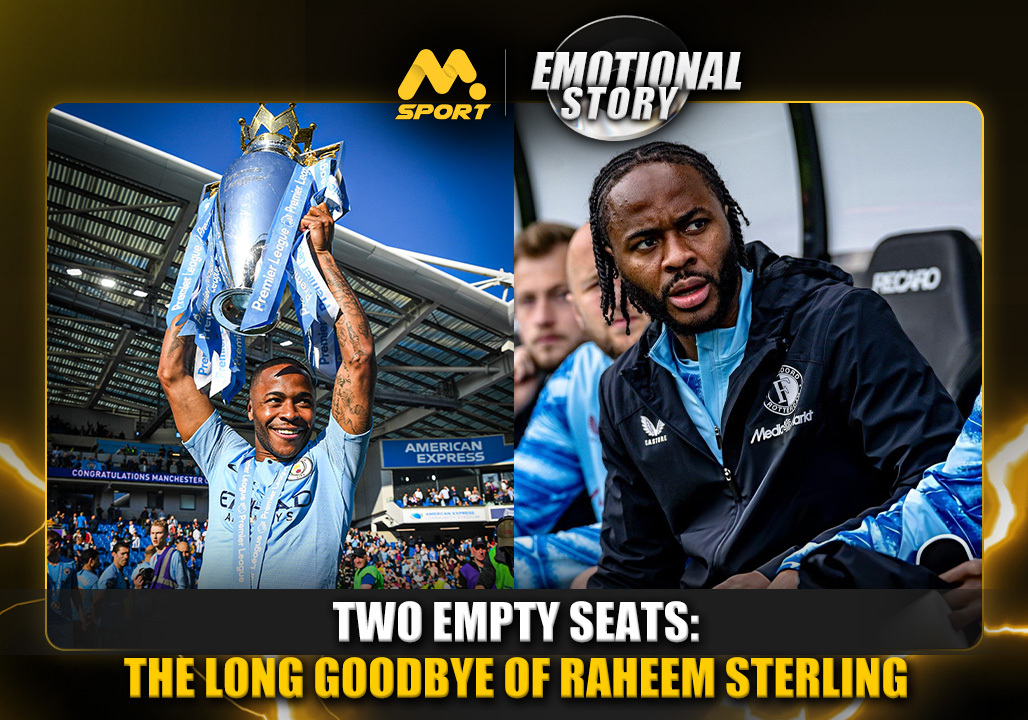
The picture reached me on a Sunday evening in Accra. Raheem Sterling, alone in the Feyenoord dugout. Two empty seats on one side. Three on the other. He had not played a minute against AZ Alkmaar. He had not moved in twenty.
I have been writing about Sterling, in one form or another, since I was a teenager. Like a lot of African football writers my age, I grew up watching him because he was one of ours in the loose, adopted way Black English players become ours. At Liverpool as a kid. At Manchester City when he scored against Germany at Euro 2020 and the WhatsApp groups went mad. We argued for him on radio. We defended him in comment sections. We wrote previews that called him world-class because we still believed he was.
That picture from Rotterdam is hard to look at if you watched him the way we did.
He is 31. Four Premier League titles. Three World Cups. UEFA team of the tournament at Euro 2020. An MBE for his work on racial equality. And he is sitting alone in a Rotterdam dugout, on a contract that ends in three weeks, with a 19-year-old midfielder playing in his position.
What the People Who Watched Him Say
I have not been to Rotterdam. Most of what I know about Sterling at Feyenoord, I know the way most football fans know anything now. Clips on my timeline. Match reports. Daniel Taylor's reporting for The Athletic. Quotes from Dutch press conferences I watch on YouTube at one in the morning Ghana time.
The verdict, even from here, is the same from everyone who has actually seen him.
Jan Everse, the former Netherlands international who played with Cruyff at Ajax, gave Taylor the line that has stayed with me since I read it.
"It's over."
Not angrily. Just flat. "He's not fit. Three sprints and you don't see him for twenty minutes. He's not explosive. He falls over his own legs. One against one, he never passes a defender. He plays the ball without risk because he has no confidence, and he has no confidence because he knows he can't do what he wants to do."
Then this. "I feel pity for him. I don't feel pity for many footballers, because I know what they earn. But I feel pity for him, because he was such a fantastic footballer."
Everse is a man who has seen footballers fade. He knows the difference between a slump and an ending. He is saying, quietly, that he is watching an ending.
What Van Persie Says, and What He Doesn't
Robin van Persie has been protecting him since January. When Sterling arrived on a free, Van Persie called it "one of the biggest transfers in the club's history." The Dutch press christened him Raheem the Dream.
Three months later, Sterling has made seven appearances. Four starts. Zero goals. One assist. After the AZ game, a reporter asked Van Persie what had gone wrong.
"The question with Raheem was never about his qualities. He was, and still is, a winner. He has worked really hard. We were building him up fitness-wise and he was slowly getting better."
Then the inevitable but.
"At the same time, we had to win every single game to achieve our goal of Champions League football."
Translation: we tried. He wasn't ready. We had a season to finish.
What the Seven Months Cost Him
Before Feyenoord, there were seven months of nothing.
Chelsea bombed him out of the squad in summer 2024. They had paid £47.5 million for him. They were paying him £325,000 a week. They did not want him in their dressing room.
Ben Rosenblatt, his personal trainer, told Taylor that Sterling spent the time doing tank-test sprints on an army training track near Surrey. Two miles of steep, snaking slopes designed to test armoured vehicles. He got the body back. Match fitness is a different country. You cannot replicate the feeling of a Premier League defender in your face by running up a tank slope in November. You can only get it from playing, and Sterling could not play, because the club paying him a quarter of a million pounds a week would not let him.
This is the part I keep coming back to. We talk about footballers as if they can be switched off and on. Seven months without competitive minutes for a 30-year-old winger is not a pause. It is an injury. The damage is what we are now watching.
What the Crowd Did at the End
Feyenoord drew 1-1 with AZ. Champions League football secured. The lap of honour began.
Sterling, who had not played a minute, walked onto the pitch. He gave his shirt to a young supporter in the stand. He hugged every player, every coach, every member of staff. He took his place on the edge of the penalty area, with the rest of the squad, facing the crowd.
And then the crowd started singing his name.
I watched it on a clip the next morning. Not ironically. Not in a way you could mistake for cruelty. They sang Raheem Sterling's name the way you sing the name of a player you remember, even if you never quite got to see what you were promised.
For a few seconds, he looked like a man who had won something.
Two Empty Seats, and a Crowd Remembering
He has one game left. Away at Zwolle. Then a conversation about the future that everyone already knows the answer to. MLS, maybe. Saudi. A Premier League club taking a low-risk gamble. Or maybe nothing.
Back to the dugout. Two empty seats on one side. Three on the other. A man who isn't playing. A man whose teammates have left a gap around him, not coldly, just because there is space and nobody happened to sit there.
It is, if you have followed him since he was 17 years old at Liverpool, the saddest picture football has produced this season. Especially if you watched him from a continent away. Especially if you remember being a teenager in Ghana telling your friends he was going to be the next big English forward.
Raheem Sterling will leave Rotterdam soon. Quietly. With his attitude intact. With the supporters who laughed at him in March having sung his name on a Sunday in May.
There is no obvious next chapter. There is just the long goodbye.