
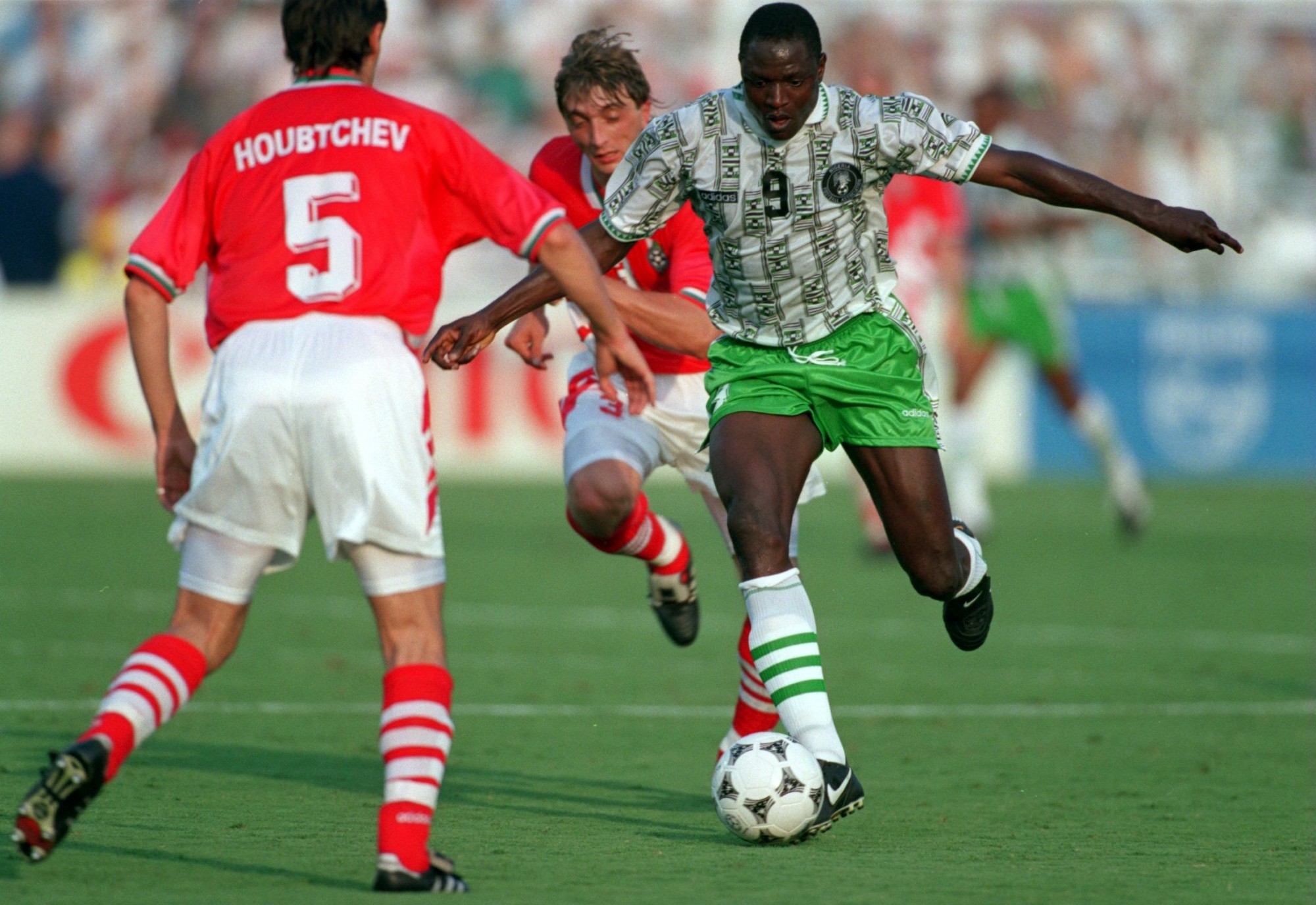
Rashidi Yekini scored the goal, ran into the net and stayed there. His arms pushed through the white squares. His face tightened. He grabbed the rope, looked upwards and shouted words nobody could clearly hear. Nigeria had waited decades to reach a World Cup. Twenty-one minutes into the country's first match, its first World Cup goal belonged to him.
The finish against Bulgaria on 21 June 1994 was simple by Yekini's standards, a tap-in from Finidi George's low cross. Everything behind it was not. He had scored eight goals during qualification, almost half of Nigeria's total. Two months earlier, he had led the Super Eagles to the Africa Cup of Nations title as the tournament's top scorer and best player. He arrived in America as the reigning African Footballer of the Year and the leading scorer in Portugal.
Before all of that, Yekini had been a mechanic's apprentice in Kaduna. Football dragged him from the workshop to UNTL, Shooting Stars, Abiola Babes, Africa Sports and eventually Europe. At Vitória de Setúbal, the tall Nigerian striker became a local hero, scoring 34 league goals to win promotion and then 21 in the top flight the following season.
The celebration inside the net did not create the legend. It captured him: powerful, emotional, proud and completely consumed by scoring for Nigeria. They called him the Goalsfather because when the country needed a goal, everyone looked for Yekini.
What They Said About Him 🗣️
I value happiness more than money. Money can't buy you peace of mind.
One of the best African players and legends to ever walk this earth.
He knew his onions and was always on hand to inspire the teams with his goals.
It doesn't matter if I equal or surpass it. Yekini is the best striker Nigeria has ever produced.
We have not yet seen the real Rashidi Yekini. It's coming.
Player Profile 📋
Full Name: Rashidi Yekini
Date of Birth: 23 October 1963
Place of Birth: Kaduna, Nigeria
Date of Death: 4 May 2012 (aged 48)
Nationality: Nigerian
Height: 1.90 m
Preferred Foot: Right
Position: Centre-Forward
Last Club: Gateway United (retired in 2005)
Style of Play
Yekini was a centre-forward designed to make defenders uncomfortable. At 1.90 metres, he had the height and leap to dominate crosses, but he was not a stationary target man. He carried his frame with surprising speed, attacked space behind the defence and used long strides to separate himself once the ball was played forward.
Inside the penalty area, his game was direct. Yekini did not need to decorate a move before finishing it. He attacked the near post, met crosses early and struck before goalkeepers could set themselves. His international record, 37 goals in 58 recognised appearances, came from anticipation as much as power. He kept arriving where the chance was about to fall.
There was range to the finishing. Headers, first-time shots, close-range touches and penalties were accompanied by a fierce right-footed strike from distance. One of his most important goals was a thunderous free-kick away to Congo during World Cup qualifying. At Setúbal, 34 league goals in 1992–93 earned promotion; 21 in the Portuguese top flight a year later proved the previous season had not been a product of weaker opposition.
He was not a modern false nine who wanted to spend the game drifting into midfield. Yekini's value came from fixing centre-backs, stretching the line and ending moves. That single-mindedness could make him look detached when the service disappeared, and his fierce personality sometimes produced friction with coaches and teammates. Give him a sight of goal, however, and the argument usually ended with the net moving.
Career
Club Career
UNTL Kaduna (1981–1982) → Shooting Stars (1982–1984) → Abiola Babes (1984–1987) → Africa Sports (1987–1990) → Vitória de Setúbal (1990–1994) → Olympiacos (1994–1995) → Sporting Gijón (1995–1996) → Vitória de Setúbal (1997) → FC Zürich (1997–1998) → CA Bizertin (1998–1999) → Al-Shabab (1999) → Africa Sports (1999–2002) → Julius Berger (2002–2003) → Gateway United (2005)
Selected Club Record
Shooting Stars — 45 goals in 53 appearances
Vitória de Setúbal — 91 goals in 114 league appearances during his first spell
1992–93 Portuguese second tier — 34 goals in 32 matches · promotion
1993–94 Primeira Divisão — 21 goals · league top scorer
Club Honours
Nigerian Premier League — 1983 (Shooting Stars)
Nigerian FA Cup — 1985, 1987 (Abiola Babes)
Côte d'Ivoire Premier Division — 1987, 1988, 1989, 1999 (Africa Sports)
Côte d'Ivoire Cup — 1989, 2002 (Africa Sports)
Saudi Crown Prince Cup — 1999 (Al-Shabab)
International
Nigeria · 58 recognised appearances | 37 goals · all-time leading scorer
1988 Olympic Games — represented Nigeria in Seoul
Africa Cup of Nations — runner-up in 1984, 1988 and 1990; third place in 1992; winner in 1994
1994 FIFA World Cup — Round of 16 · scored Nigeria's first World Cup goal
1998 FIFA World Cup — Round of 16 · final Nigeria appearance against Denmark
AFCON record — 13 goals in five tournaments
Individual
African Footballer of the Year — 1993 · first Nigerian winner
AFCON top scorer — 1992, 1994
AFCON Best Player — 1994
Primeira Divisão Bola de Prata — 1993–94
Portuguese second-tier top scorer — 1992–93
Nigeria's all-time leading goalscorer — 37 goals
Final Words
The photograph makes it tempting to leave Yekini's story in 1994. He is inside the net, Nigeria is announcing itself to the world, and everything ahead appears bright. At 30, he was African champion, African Footballer of the Year, Portugal's top scorer and the most important striker his country had ever produced.
Football turned quickly. His move to Olympiacos collapsed after disagreements with coaches and teammates. A knee injury suffered while playing for Nigeria at Wembley kept him out for six months. Sporting Gijón and a return to Setúbal brought only flashes of the old force, although 14 goals for FC Zürich earned him a place at the 1998 World Cup.
After retirement, Yekini withdrew. He rejected interviews and football roles, lived increasingly alone and died in Ibadan on 4 May 2012, aged 48. Reports about his health and the circumstances of his final weeks conflicted, and members of his family later disputed parts of the public account. What is certain is that one of Nigeria's most celebrated athletes spent his last years far from the noise he had once created.
That makes the net image harder to view, but also more important. It reminds football to remember the person after the goals stop. Yekini gave Nigeria 37 of them in just 58 recognised appearances. He carried the country through its first World Cup qualification, won its second African title and became the first Nigerian named Africa's best player.
Victor Osimhen has moved within two goals of the record and may eventually pass it. Osimhen himself still calls Yekini the greatest striker Nigeria has produced. Numbers can be overtaken. The first can never be repeated.