

Jomo Sono was carrying a tray of apples into Natalspruit Ground when Orlando Pirates found themselves one player short for an exhibition match. Their coach knew Sono's late father and asked the 14-year-old to fill in. Sono agreed on one condition: the coach had to buy the entire tray. Then the boy selling the apples scored twice.
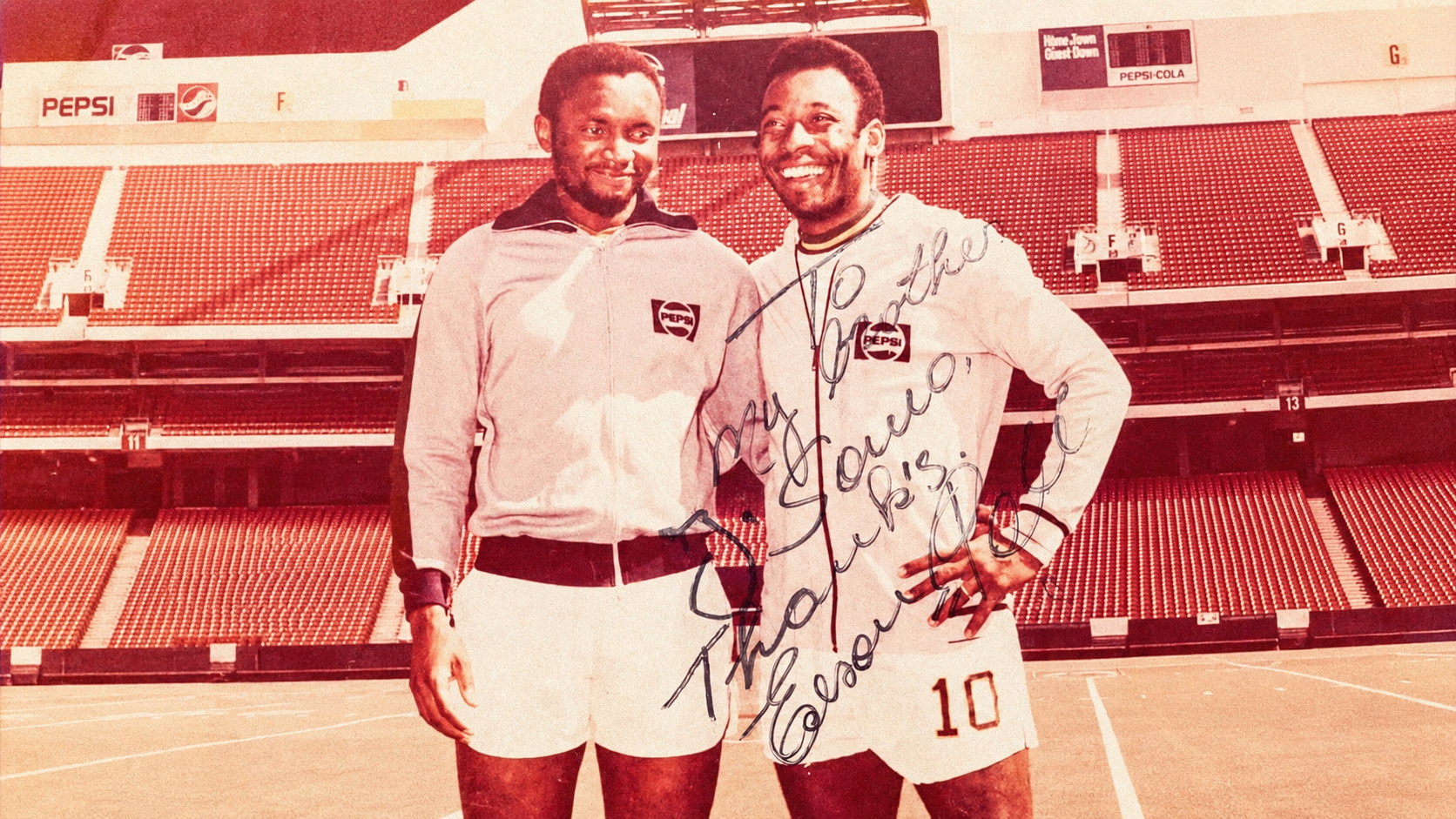
Eight years later, he was in New York sharing a dressing room with Pelé, Franz Beckenbauer and Carlos Alberto. Sono played 12 league matches as the Cosmos won the 1977 North American Soccer League title in Pelé's final season. After the final, the Brazilian gave him a hug Sono would still be describing 45 years later.
The distance between those moments was enormous. Sono's father, Orlando Pirates midfielder Eric “Scara” Bhamuza Sono, died in a car crash when Jomo was eight. His mother left, and he was raised by his ailing grandparents in a small Soweto home. Money for food, clothes and school fees came from selling apples and peanuts at football grounds and train stations.
Football did not simply take Sono from outside the stadium to the pitch. It gave South Africa its Black Prince, gave Pelé a teammate, and eventually gave generations of young players the opportunity Sono had once needed for himself.
What They Said About Him 🗣️
It was my dream just to see this man, but God made it possible for me to play with him.
I never-ever want to forget the contribution he has done for me.
When we see Jomo Sono, we see Orlando Pirates.
He has excelled as a gifted player, as a coach and a mentor who takes efforts to unearth youth soccer talent.
Underestimate Bafana Bafana at your own peril.
Player Profile 📋
Full Name: Matsilela Ephraim “Jomo” Sono
Date of Birth: 17 July 1955
Place of Birth: Orlando East, Soweto, Johannesburg, South Africa
Nationality: South African
Height: 1.73 m
Preferred Foot: Right
Position: Attacking Midfielder / Forward
Nickname: The Black Prince / Bra J / Mjomana
Current Role: Owner and chairman of Jomo Cosmos
Style of Play
Sono was South Africa's classic number ten before the role became a tactical diagram. At 1.73 metres, he played with a low centre of gravity, close control and the confidence to invite pressure. Defenders stepped towards him because he appeared to be holding the ball too long. That was usually when the feint arrived.
His dribbling was not only about speed. Sono changed rhythm, paused over the ball and used his body to send an opponent in the wrong direction before slipping through the space they had opened. The same disguise shaped his passing. He could carry possession through midfield, draw two defenders and release a forward with an accurately weighted final ball.
He was also productive. Across six outdoor NASL seasons from 1977 to 1982, Sono recorded 36 goals and 33 assists in 128 league appearances. His best campaign came with Toronto Blizzard in 1980, when he produced 14 goals and seven assists in 31 matches. He could operate as an attacking midfielder, a second striker or the main creative forward without losing his influence.
Sono played for possibility rather than safety. He attempted the dribble, the disguised pass and the unexpected finish, which could make him difficult to contain and occasionally difficult to structure. Under modern terminology, he would be called a high-risk creator. South African supporters called him the Black Prince because the ball appeared to obey him.
Career
Club Career
Orlando Pirates (1972–1977) → New York Cosmos (1977) → Colorado Caribous (1978) → Atlanta Chiefs (1979) → Toronto Blizzard (1980–1982) → Jomo Cosmos (player-owner after returning to South Africa)
Sono also spent time with Sporting CP and Juventus, but South Africa's international isolation and work-permit obstacles prevented permanent European moves.
North American Record
New York Cosmos — 12 league appearances | 1 goal
Colorado Caribous — 30 appearances | 8 goals | 5 assists
Atlanta Chiefs — 29 appearances | 5 goals | 12 assists
Toronto Blizzard — 57 appearances | 22 goals | 16 assists
NASL outdoor total — 128 appearances | 36 goals | 33 assists
Selected Honours as a Player
National Professional Soccer League — 1973, 1975, 1976 (Orlando Pirates)
Life Challenge Cup — 1973, 1974, 1975 (Orlando Pirates)
North American Soccer League — 1977 (New York Cosmos)
International
Sono's prime fell during South Africa's exclusion from FIFA because of apartheid. He therefore never received the recognised senior international career his talent deserved. South Africa was readmitted only in 1992, years after his playing peak.
Club Owner, Developer and Coach
Purchased Highlands Park — 1982; established the club that became Jomo Cosmos in 1983 and officially adopted the Jomo Cosmos name in 1984
National Soccer League champion — 1987
Bob Save Super Bowl — 1990
Coca-Cola Cup — 2002, 2005
SAA Supa 8 — 2003
Players identified or developed through Sono and Cosmos include Pitso Mosimane, Philemon Masinga, Helman Mkhalele, Sizwe Motaung, Mark Fish, Thomas Madigage, Andrew Rabutla and Nkosinathi Nhleko.
South Africa Coaching Career
1996 Africa Cup of Nations — technical adviser as South Africa won the title
1998 Africa Cup of Nations — caretaker coach; runners-up after taking charge less than two weeks before the tournament
2002 FIFA World Cup — caretaker coach; four points and five goals, eliminated behind Paraguay on goals scored
Recognition
Order of Ikhamanga in Silver — 2014, for his contribution to South African football as a player, coach and developer of talent
Honorary doctorates — 2016, recognising his contribution to football and business
Final Words
The photograph with Pelé is the easy way to explain Jomo Sono's greatness. A boy from Soweto reached New York, stood beside the most famous footballer alive and finished the 1977 season as a North American champion. It is a story that barely sounds real.
It is still only half the story. Apartheid denied Sono the chance to represent his country in recognised international football during his prime. Instead of allowing that exclusion to become the final word, he returned home, bought a club and began constructing pathways for other players.
Jomo Cosmos became a talent factory. Philemon Masinga, Helman Mkhalele, Sizwe Motaung and Mark Fish were among the players Sono helped discover or develop before they became internationals. His recruits formed part of the core of the South Africa side that won the 1996 Africa Cup of Nations. Pitso Mosimane began his senior career under Sono and later became one of Africa's most decorated modern coaches.
Then Sono took charge of the country he had never been allowed to represent officially. Given less than two weeks to prepare for the 1998 Africa Cup of Nations, he led Bafana Bafana to the final. At the 2002 World Cup, South Africa collected four points, scored five goals and missed the knockout stage only because Paraguay had scored one more.
The legacy has not been tidy. Jomo Cosmos suffered repeated relegations and eventually fell into semi-professional football. Sono stayed. The same man who once sold fruit to survive was still visiting lower-league grounds in 2026, searching personally for the next player other clubs had missed.
Pelé showed him how far football could carry one life. Sono spent the rest of his own proving how many other lives one footballer could carry with him.
The boy outside the stadium did not simply get in. He spent the rest of his life holding the gate open.