
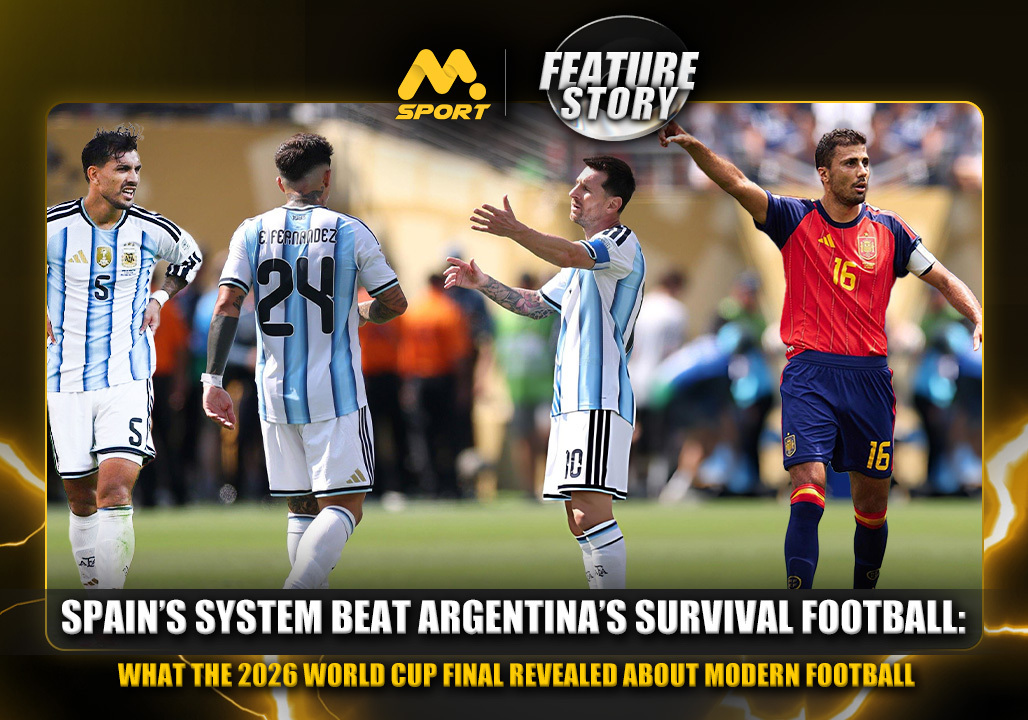
For 105 minutes, Argentina made not-losing look like a plan.
They didn't test Unai Simón once in regulation. They didn't string possession together in Spain's half. They spent the World Cup final defending Emi Martínez's box and waiting for penalties, where they've made a habit of breaking hearts. And with fourteen minutes left before the shootout, it was still 0-0 and it was almost working.
Then Pedro Porro crossed from the right, Nico Williams won the header at the back post, and Ferran Torres arrived ahead of Argentina's midfield to finish the knockdown in the 106th minute. 1-0. Spain's second World Cup, sixteen years after their first.
Here's the thing that final revealed, and it's bigger than one goal. Two of the three players involved in that winner had started on the bench. Spain changed personnel, changed the shape of their attack, added new physical qualities, and never once lost their structure. Argentina, meanwhile, had spent two hours removing everything from their game except the ability to survive. One team kept finding new ways to win. The other reduced the biggest match in football to how long it could avoid losing.
The Final Was Control Against Dependence
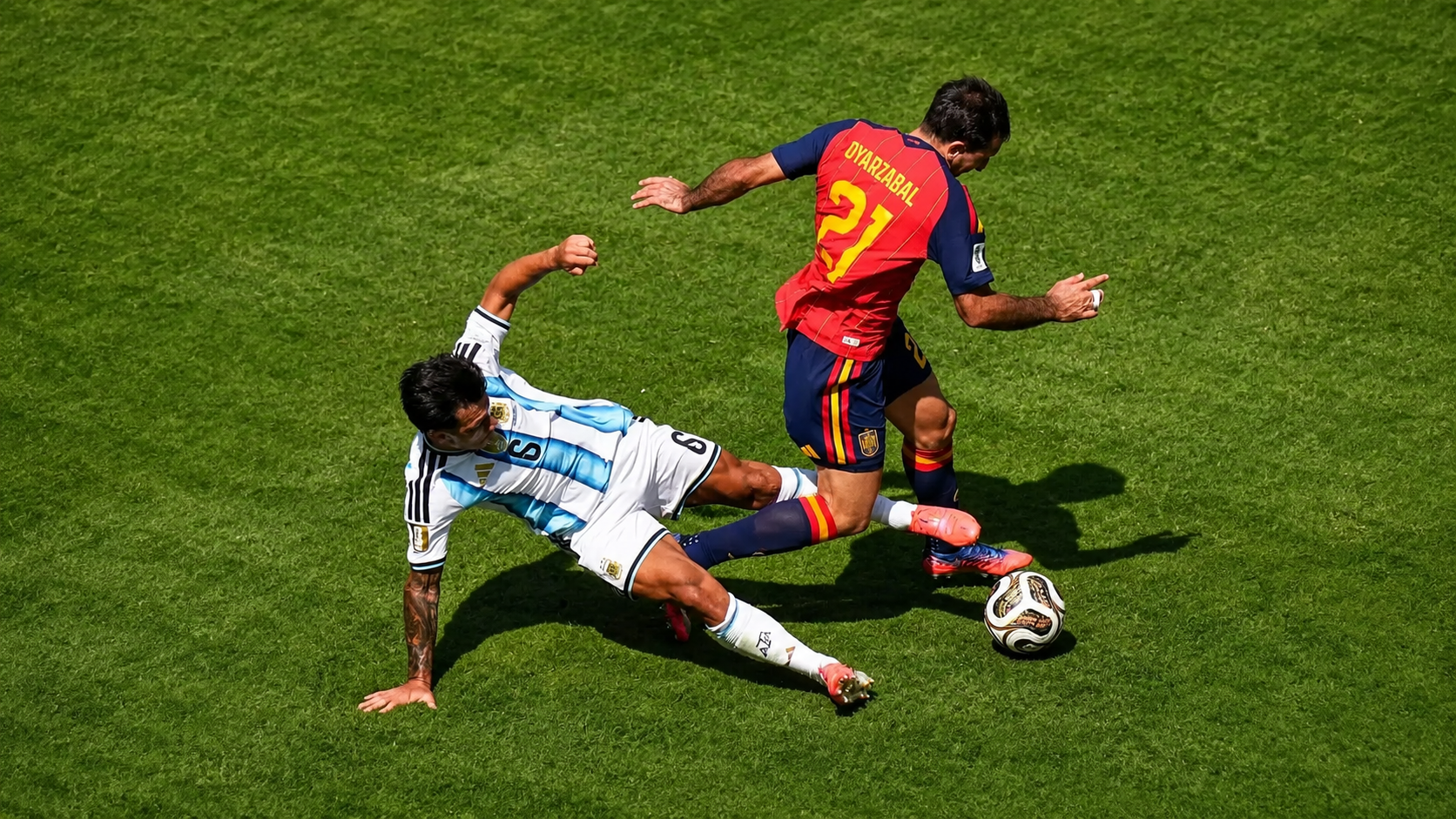
Image credit (Getty Images)
Spain lined up in a 4-2-3-1. Rodri and Fabián Ruiz behind Baena, Olmo and Yamal, with Oyarzabal nominally up top but constantly dropping off Argentina's centre-backs. Argentina stuck with the narrow 4-4-2 that carried them through the tournament, Messi and Alvarez up front, a compact midfield block behind.
Scaloni's plan was defensible. Sit deep, protect the centre, make Spain break down a wall. And for a long time Romero and Lisandro Martínez managed the space between the lines beautifully, stepping out to stop Olmo turning, forcing Spain to circulate and go again.
The problem is what that plan demanded. Spain didn't need every rotation to work. They needed Argentina to defend every single rotation correctly for two hours straight. One winger drifting inside while the other held width. One full-back overlapping while the other tucked in for safety. The striker dropping while a midfielder attacked the space he vacated. Argentina could always see the ball. What they couldn't do was predict which Spanish player would be occupying which space next.
And when Argentina did win it back, they had nowhere to go. Messi and Alvarez were marooned against Laporte, Cubarsí and a recovering Rodri, too far from their own midfield to link up. Every clearance came straight back. The numbers are brutal: Spain finished with 20 shots, Argentina managed two. Spain's expected goals were 1.94 to Argentina's 0.20. Argentina didn't register a single shot in regulation time. They defended their penalty box. Spain defended the entire pitch.
Rodri Was the Whole System in One Man
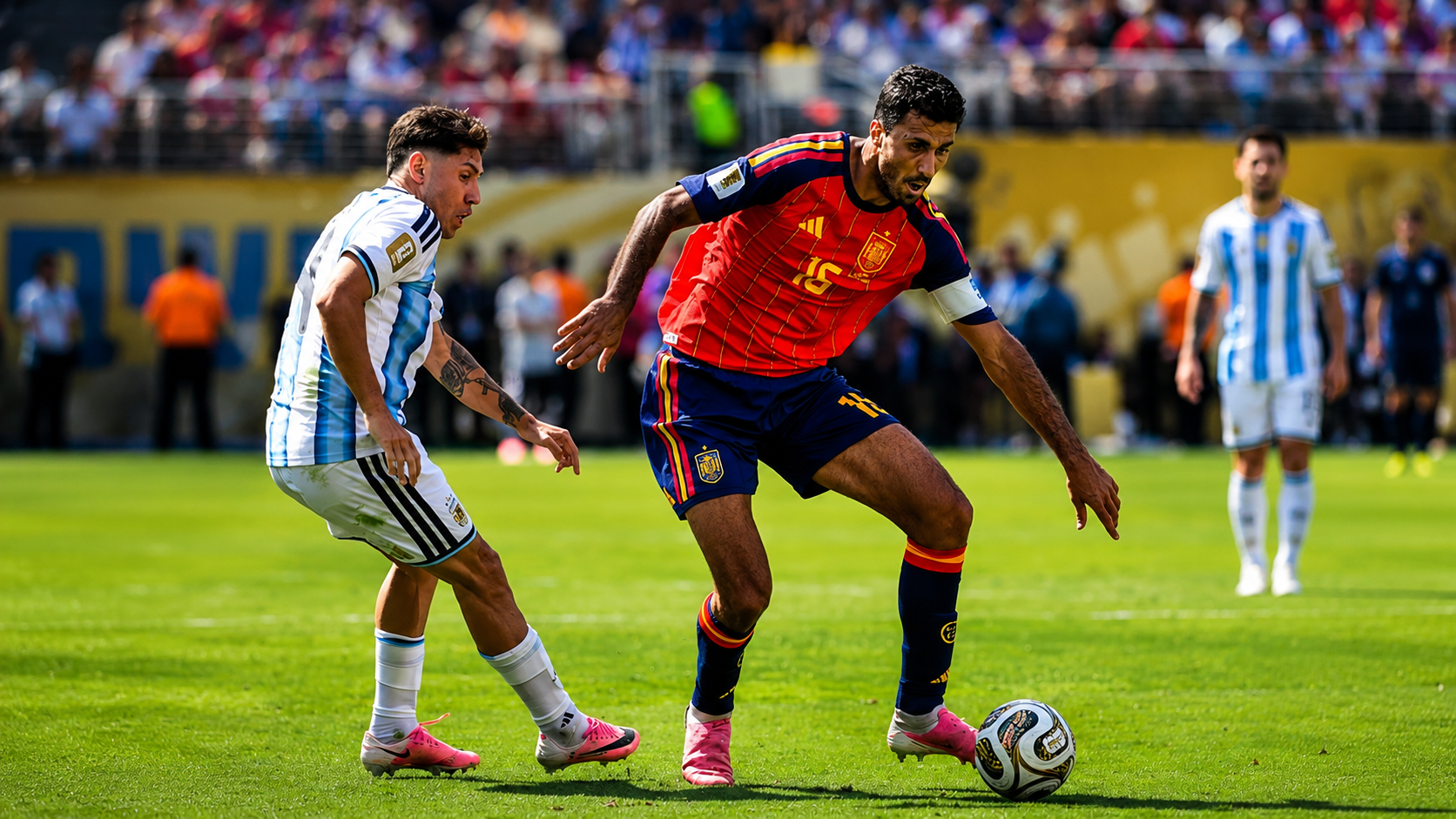
Photo Credit (Getty Images)
If you want to understand why Spain won, watch Rodri, who walked away with the Golden Ball and deserved it.
He completed 101 of 106 passes, a 95.3% success rate, his best of the tournament. He made four tackles and won 80% of his ground duels. But the stats undersell him, because his real job was deciding when Spain accelerated and when they held, offering himself behind Argentina's front two, and shielding the centre every time a full-back pushed on.
His most important moment was defensive. In the 92nd minute Messi got one of his only sniffs at an unsettled Spanish backline, and Rodri simply recovered and took the ball off him before he reached the box. That's the whole idea in one action: Spain's possession was also their defence. Opponents could occasionally play around their midfield. Almost nobody played through it.
Across eight games Spain conceded one goal, the fewest of any World Cup winner ever, and they did it playing more matches than any champion before them. Modern possession isn't just about creating chances anymore. Done right, with the positioning and the counter-press Rodri anchored, it stops the other team from ever attacking you. Argentina spent the night defending. Rodri made sure Spain never had to.
Spain Built a System, Not Just a Team
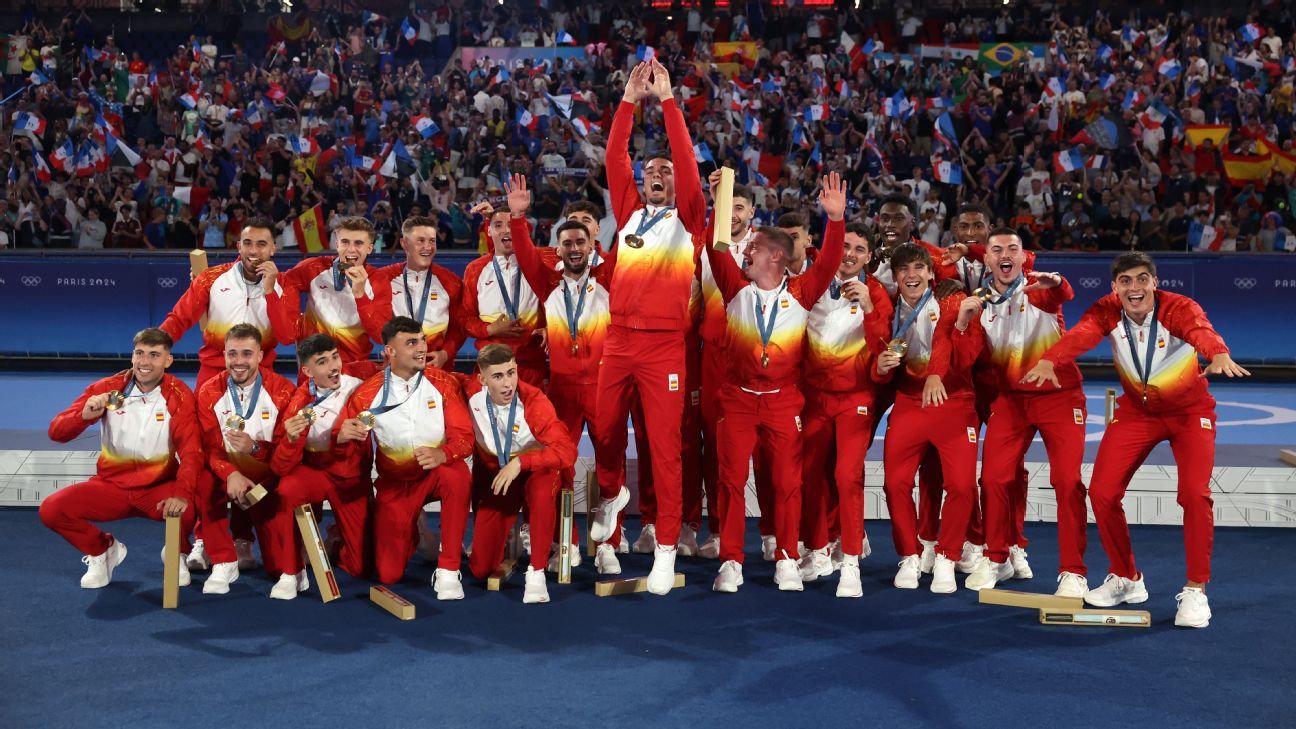
Photo Credit (Olympics)
Here's the part every other federation should be scared of. Spain's win didn't start when Luis de la Fuente picked his squad. It started years earlier.
De la Fuente coached Spain at Under-19, Under-21 and Olympic level before he got the senior job. So when Cubarsí, Gavi and Yamal arrived in the senior setup, they weren't learning a new language. Playing through pressure, defending with the ball, pressing the instant they lost it, all of it was already baked into their football education. The senior team isn't a separate institution that meets a few times a year. It's the final stage of one continuous development pipeline.
And it isn't built on one academy or one star. Rodri came through Villarreal and Atlético. Yamal, Cubarsí and Olmo through Barcelona. Oyarzabal and Zubimendi through Real Sociedad. Williams through Athletic. Different academies, different regions, one shared idea of how football should be played. Spain now hold the men's and women's World Cups, plus the Nations League, the Euros and Olympic gold in the same cycle. That's not a lucky generation. That's an institution.
Messi gave Argentina an identity for two decades. When he goes, so does a lot of it. Spain have built an identity that survives the retirement or injury of anyone in it. That's the more sustainable model, and everybody just watched it win.
Federations Will Try to Buy This. Most Will Fail.
Photo Credit ( CAF)
Spain's triumph is going to change how associations hire. For years the search has been for a coach who can qualify you for the next tournament. Now it'll be for an entire methodology, one way of building from the back and developing midfielders that runs from the Under-17s all the way up.
England will have to ask whether importing another big-name foreign manager beats developing someone inside the FA who already knows the youth pathway. Brazil will have to look at what constant managerial turnover has cost them. And African federations, Ghana and Nigeria included, will start asking not just who coaches the senior team, but how that coach's football connects to the Under-20s and Under-23s underneath them.
But plenty will get it wrong. Some federation will hire a Spanish coach, demand 65% possession, and think they've copied Spain. They haven't. Possession is the visible result of the system, not the system itself. Without technically secure defenders, coordinated movement, educated youth coaches and years of tactical continuity, you get the passing numbers without the control. You get the ball, and no idea what to do with it.
It's already happening at club level, mind you. Five Spanish managers start next Premier League season: Arteta at Arsenal, Emery at Villa, Iraola at Liverpool, Alonso at Chelsea, Arbeloa at Fulham. Add Luis Enrique's back-to-back Champions Leagues at PSG and de la Fuente's World Cup, and the Spanish coaching school is the most valuable export in the sport. The tell is that they don't all play the same way. Arteta controls territory, Iraola goes vertical, Emery adapts to the opponent. They're not exporting a formation. They're exporting an education in space and structure.
Every Great System Breeds Its Own Counter
Photo Credit (Getty Images)
None of this means everyone becomes Spain now. Football always answers dominance, and the blueprint to beat this side already exists in fragments.
Argentina wrote part of it. Their narrow block genuinely frustrated Spain for long stretches and forced them wide. What Argentina lacked was any transition threat, any reason for Spain to fear losing the ball. They cleared it towards an isolated Messi and got it straight back. The next team to try this keeps two quick attackers high even at the cost of a defender, and swaps the isolated 37-year-old for a striker who can actually hold the ball and make Spain retreat.
Give Argentina's defensive organisation a Haaland to run onto those clearances and it's a completely different problem. France, with their pace and power, could be a complete counter-model if they organise it right. And Cubarsí's stoppage-time red card, after Enzo's earlier dismissal left Argentina with ten, is a reminder that Spain aren't untouchable, they just make you play near-perfectly to punish them.
That's where the next tactical era goes. Not Spain against the world, but a race to fuse Spain's control with the directness and physical power their system is specifically designed to smother. The winners of the next cycle will be hybrids, teams that dominate the ball without slowing down, press high without getting exposed, and attack directly without losing their shape.
They Kept the Ball. More Importantly, They Kept Their Choices.
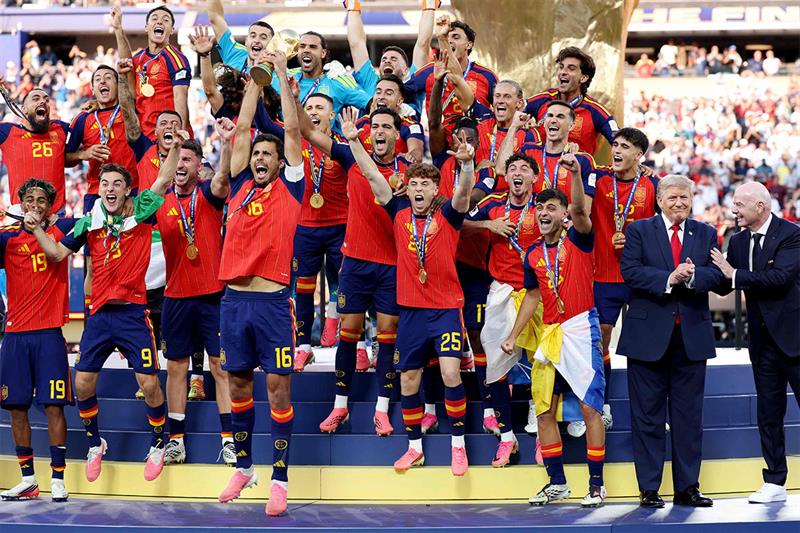
Photo Credit (Getty Images)
Emi Martínez made eleven saves, a World Cup final record, and still lost. That's the whole story in one stat. Argentina survived Spain for 105 minutes and never once made Spain afraid of them. They had discipline without release, resistance without a counter-punch, and a route to penalties without a route to actually winning.
Spain kept the ball all night. More importantly, they kept their choices. Every time Argentina closed one door, Spain opened another, until Ferran Torres walked through the last one in the 106th minute.
That's what the 2026 final revealed about where football is going. It was never possession against counterattack. It was control against dependence. And now the rest of the world has to figure out how to build what Spain spent fifteen years building, or how to blow it up. Either way, they're all chasing Madrid's neighbours now.